
Long Rectangular Garden Design Layout Ideas That Stop the Corridor Feel

A long rectangular garden is one of the most common plots in the UK, and one of the hardest to make feel right. The geometry pulls the eye straight to the back fence. Without a deliberate layout, the garden reads like a corridor, with everything visible at once and nowhere to settle.
The fix isn't a complete redesign. A few specific layout moves can break the corridor effect and turn a long rectangle into the most usable shape of garden you can have.
Here are seven long rectangular garden design layout ideas I use, with examples from real projects.
What is a long rectangular garden?
A long rectangular garden is a plot where the length is at least twice the width, giving it a noticeably elongated shape. Most UK terraced and semi-detached homes have this footprint, with widths between 4 and 8 metres and lengths from 12 to 25 metres or more.
The proportions are the source of the design challenge. A 5 metre wide, 20 metre long garden has the same surface area as a 10 metre square, but feels completely different to use. The job of a layout is to make the rectangle feel like a series of usable spaces rather than a single long one.

Why long rectangular gardens feel awkward
The shape itself isn't the problem. The way the shape pulls the eye is.
Long rectangular gardens tend to:
Read as corridors, with all the planting visible from the back doors and nothing left to discover.
Lack a clear focal point, because the back fence becomes the default destination by accident rather than design.
Make borders feel thin, since shallow strips along the side fences can't carry layered planting.
Concentrate use near the house, leaving the far end as a wasted zone for sheds, bins or compost.
Feel exposed, with a single long sightline making it hard to find a private spot.
Resist symmetrical layouts, because anything centred down the length emphasises the corridor effect rather than fixing it.
For broader principles of garden layout, the RHS guidance on garden design covers planning at a useful level.

7 long rectangular garden design layouts that work
Each idea below tackles the corridor effect from a different angle. Use one or stack a few together.
1. Divide the garden into three rooms
The single most effective move in a long rectangular garden is to split it into clear zones, usually three. A near-house area for daily use, a middle transition zone, and a destination at the far end. Each zone gets its own purpose and its own boundary, even if that boundary is as light as a change in paving or a shift in planting.
For an example of how zoned planning works in practice, my garden design project in Bromley treats the garden as a series of rooms for BBQs, outdoor dining and relaxing, with a stepping stone path connecting them. The result is a garden where each section has a job, rather than a single space that tries to do everything.

2. Use a curved path to break the straight line
A path that runs straight down the centre of a long garden makes the corridor feel worse. A path that curves, even gently, slows the eye down and reveals different parts of the garden in sequence. The curve doesn't need to be dramatic. A 1-metre offset over a 10-metre run is enough to change the visual rhythm.
The same applies to lawn shapes, border edges and any other design line that could otherwise run dead straight from the house to the back fence.
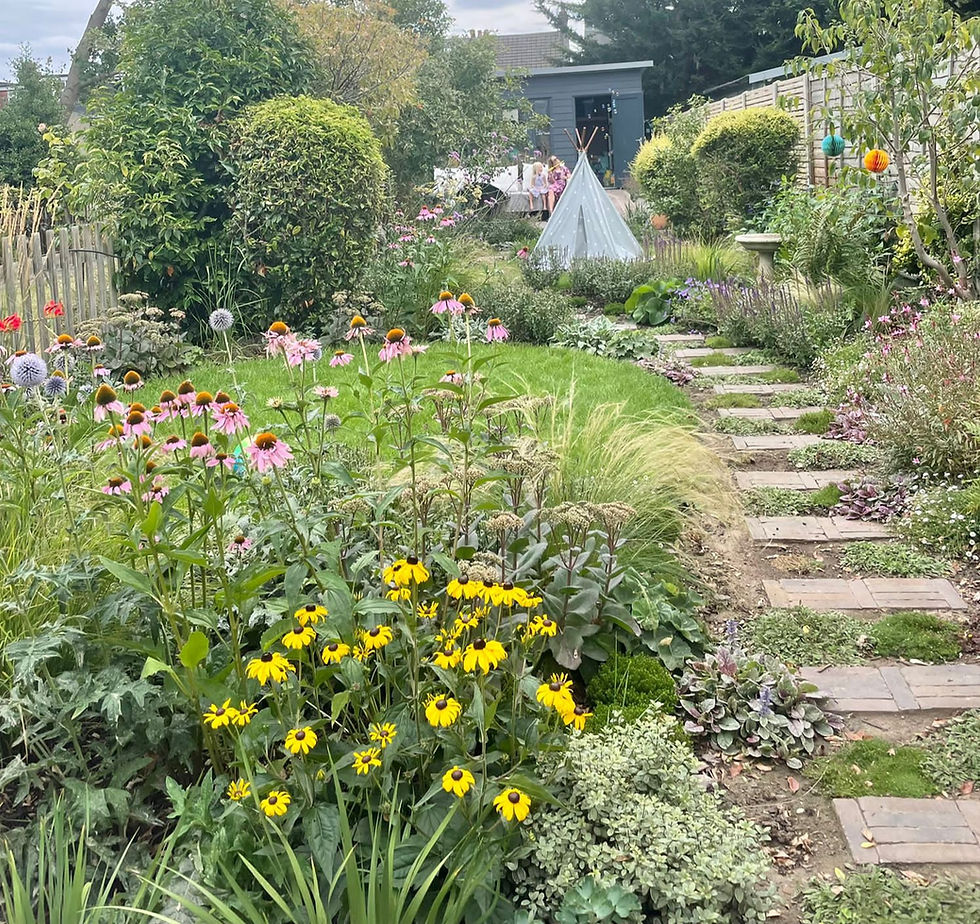
3. Vary the width with pinch points and expansions
Where the plot is the same width from end to end, the layout can do the work of varying it. Plant deeply in some sections and lightly in others. Use a wider patio at the house, narrow into a path through the middle, and open out again at the back. The plot starts to feel composed of distinct spaces rather than a single tube.
My garden design project in Long Ditton uses several seating areas connected by clay paver paths, with planting widening and narrowing along the route. The garden reads as a sequence of moments rather than a single long view.

4. Place a focal point at the far end
Long sightlines need a destination. A specimen tree, a sculpture, a bench, a water feature, anything that gives the eye something to land on at the back of the plot. Without it, the eye runs to the back fence and stops there.
The focal point doesn't have to be expensive or elaborate. A multi-stem birch with a simple bench beneath it does the job. So does a single olive tree in a generous pot, or a piece of weathered stone.
5. Plant to soften the boundaries
A long rectangular garden with bare side fences feels like a runway. The same plot with deep, layered planting along both sides feels like a garden. The fences should disappear behind the planting, so the eye reads the garden as a green volume rather than a defined rectangle.
Aim for borders at least 1.5 metres deep along both long sides. Anything narrower and the planting can't layer properly. Depth is more important than length.
For a contemporary example of how structured planting can hold a layout together, my garden design project in Molesey uses a year-round planting scheme with seamless transitions between different zones. The same disciplined approach works in a long rectangular plot to soften the boundaries and connect each section.

6. Lay hard landscaping on the diagonal
Paving laid square to the house emphasises the corridor effect. Paving laid at 45 degrees to the boundaries breaks the geometry and pulls the eye sideways rather than forwards. The same applies to decking boards, raised bed alignment, and even lawn shape.
The diagonal trick is especially useful in terraced housing, which is why I reach for it regularly when providing garden design service in Croydon and other south London neighbourhoods where long, narrow rear plots are the norm. Even modest changes to paving direction make a tangible difference.
7. Build a real destination at the back of the plot
The most underused part of a long rectangular garden is usually the far end. Treat that end as a real destination, not a leftover, and the whole plot starts to make sense.
A garden office, a summer house, a built-in bench under a pergola, a fire pit area. Anything that gives you a reason to walk to the back of the garden. My garden design project for a long narrow garden in Beckenham handled exactly this by placing a raised home office at the far end, with a ramped clay paver path leading to it through DesignClad raised beds. The route to the back of the garden became a feature in itself.

How to plan a long rectangular garden
To plan a long rectangular garden, divide the length into three roughly equal zones, place the most-used zone closest to the house, set a clear focal point at the far end, and use deep planting along both side boundaries to disguise the fences. The aim is a sequence of usable rooms, not a single long view.
In practice, the planning order is:
Decide the destination at the far end first. Garden office, summer house, seating area, specimen tree. The destination determines the route through the rest of the plot.
Place the near-house zone to support daily use, usually dining, kitchen access and evening lounging.
Plan the middle as a transition, not a fourth room. It can be planting-led, with a path, a small focal point or a change in level.
Choose the path style that connects them. Curved softens, diagonal stretches, straight emphasises the corridor.
Layer the planting along the boundaries so the side fences disappear behind the green.
I'd avoid placing major features dead-centre along the length of the plot. The symmetry only emphasises what makes the shape difficult.
Common mistakes I see
Three patterns come up repeatedly when long rectangular gardens are designed in the wrong order.
Treating the back of the garden as leftover. The far end usually ends up holding the shed, the compost and the bins by default. That makes the garden feel half-used, with the eye running to a cluttered horizon. A real destination at the far end transforms the whole plot.
Centred symmetry that emphasises the corridor. A path running straight down the middle, a lawn dead-centre between two fences, planting in matched stripes either side. Each one pulls the eye straight to the back. Off-centring a feature, even slightly, breaks the effect.
Borders that are too narrow. Long rectangular plots tempt people into thin borders along both fences. The result is a stripe rather than a border, and the planting never gets enough depth to soften the geometry. A single deeper border with a narrower second one will read better than two shallow strips.
Want a layout designed for your long garden?
A long rectangular garden has more potential than almost any other plot, once the corridor effect is broken. The trick is in the planning order, not the planting list. I design gardens across London, Kent and the South East, including garden design in Notting Hill and other tightly enclosed urban plots, and every project starts with a free site visit and a careful read of the plot's proportions. If you'd like a layout drawn up specifically for your long rectangular garden, get in touch and we'll arrange a visit.


Comments