
Ideas for Paving Garden Spaces

Updated: 6 days ago
At OB Garden Design, we see paving as far more than a practical surface. Done well, it shapes how a garden feels, how it flows, and how it is used from day to day. Our approach is always to design outdoor spaces around real life, whether that means room to entertain, a quieter place to unwind, or a layout that feels like a natural extension of the house. We also focus on gardens that feel joyful, beautiful, climate-resilient, and full of life, so hard landscaping needs to work alongside planting rather than dominate it.
For homeowners, the best paving ideas usually start with one question: what do you want the garden to do? A paved garden can create structure, improve circulation, define zones, and make outdoor living easier, but the material, scale, and layout all need to suit the house and the way the space will be used. On our own projects, we often design gardens as a series of connected areas for dining, relaxing, cooking, and moving through the space, rather than treating paving as one large blanket surface.

Start with a Main Patio That Anchors the Garden
One of the strongest ideas for paving garden spaces is to begin with a main patio close to the house. We often design this as the foundation of the garden because it creates an immediate usable area and helps build a natural visual and physical flow between indoors and outdoors. On the OB Garden Design site, we describe the patio as the heart of modern outdoor living and often place it so it feels connected to the home rather than detached from it.
This does not mean the entire garden should be paved. In most cases, the main terrace works best when it acts as the starting point, with the rest of the layout opening into planting, lawn, paths, or secondary seating areas. That balance usually creates a more generous and more considered garden than paving everything in one go. This is our design judgement based on the way we structure gardens around lifestyle, movement, and layered planting.
Use Large-Format Paving for a Clean, Contemporary Feel
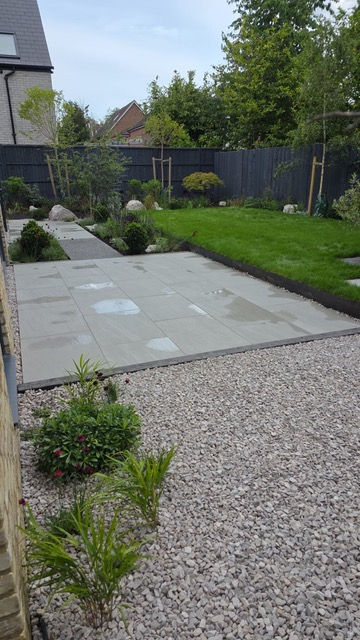
If the aim is a modern garden, large-format paving is one of the simplest ways to achieve it. In our own patio guidance, we highlight large paving slabs, neutral palettes, and clean lines as key features of a contemporary patio. That approach works particularly well in new-build settings or in gardens that need to feel polished, uncluttered, and easy to maintain.
Large slabs can also make a space feel calmer because there are fewer joints and less visual fuss. We often like this direction when the house already has a contemporary feel or when sliding doors open straight onto the garden and the outside space needs to feel like a continuation of the architecture. That emphasis on seamless living and clean, connected spaces runs through our service and project pages.

Choose Natural Stone for a Softer, More Timeless Look
For a more classic or organic effect, natural stone remains one of the best paving ideas for a garden. On our own site, we describe sandstone and limestone as materials that bring warmth, texture, and character, especially when paired with softer planting. We also note that this style works particularly well with period properties or gardens that need a more timeless feel.
Natural stone is often useful when the goal is not perfection, but character. Slight variation in tone and surface can help a garden feel established and relaxed rather than overly engineered. In our view, it is especially effective when combined with looser planting, curved beds, and a palette that feels close to the surrounding landscape. That reflects our broader ethos of creating gardens that feel natural, balanced, and as though they have always belonged there.

Break the Garden into Paved Zones
A common mistake is treating paving as one single feature. We usually find that gardens work better when paving helps create zones. On our service pages, we talk about gardens as a series of rooms for different uses, including outdoor dining, cooking, and relaxing, and that principle can shape the paving layout just as much as the planting plan.
For example, one garden might have a dining terrace near the house, a smaller paved seating nook further back, and a linking path between the two. Another might use paving to define a lounge area, an outdoor kitchen, and a threshold between lawn and borders. This kind of zoning often makes a garden feel bigger because it gives each part of the space a purpose instead of leaving everything visually unresolved. That is an inference from the design approach OB Garden Design describes across its service and project pages.

Use Light-Coloured Paving to Open Up a Small Garden
When space is limited, colour matters. In our patio article, we note that light-coloured paving can create a greater sense of openness in smaller gardens. This is one of the easiest ideas to apply when a compact plot feels narrow, enclosed, or overshadowed.
We also tend to combine that lighter paving with clear zoning, vertical planting, or raised beds so the space feels organised rather than crowded. The point is not just to make the garden look brighter, but to make it read more clearly. On our site, we consistently emphasise thoughtful layout and making the most of every inch, especially in courtyards and smaller urban gardens.

Add Stepping Stone Paths Through Planting
Not every paved route needs to be a full path. One of our favourite ideas for paving garden spaces is to use stepping stones through gravel, lawn, or planting. On a featured project page, we describe using a simple stepping stone path to guide movement through the space while allowing the planting to take centre stage.
This approach can make a garden feel more immersive and less dominated by hard landscaping. It is particularly effective where the aim is to create a softer journey through the space or to draw attention to surrounding greenery. Because we place such a strong emphasis on biodiversity, layered planting, and views through the garden, stepping stones are often a more elegant answer than a wide expanse of paving from edge to edge.

Use Multi-Level Paving to Create Interest
If a garden slopes, or if the layout feels flat and one-dimensional, level changes can be a powerful design tool. In our patio ideas article, we explain that multi-level patios can separate dining, lounging, and planting areas, improve usability on sloped gardens, and create a stronger sense of journey through the space.
Even in a fairly modest garden, a raised terrace, a sunken seating space, or a change in level between the house and lawn can make the design feel more intentional. The key is to make those changes feel easy and integrated rather than awkward. Steps, retaining walls, and raised platforms can all support that, especially when the materials and planting are handled as part of one coherent scheme.

Soften Paving with Planting at the Edges
One of the best paving ideas is often not about the paving itself, but about what sits beside it. On one of our London projects, we describe bringing low-level greenery right up to the sliding doors to blur the boundary between home and garden. That same principle works beautifully with paved spaces.
Rather than leaving paving exposed on all sides, we usually prefer to soften edges with planting beds, specimen shrubs, or lower textural planting. It helps the hard landscaping sit more comfortably in the garden and prevents the space from feeling stark. This ties closely to our broader design approach, which combines practical layout choices with biodiverse, wildlife-friendly planting and gardens that feel alive throughout the year.

Introduce Detail with Borders, Banding, or Material Changes
A paved garden does not have to rely on one material alone. Sometimes the most effective idea is to keep the main paving simple, then introduce interest through details such as border courses, banding, or subtle changes in texture. While our site focuses more on layout than decorative flourishes, the overall emphasis on high-quality materials, thoughtful design, and tailored solutions supports this more refined approach.
In practice, that might mean framing a porcelain terrace with a darker set edge, using stone setts to define a dining space, or shifting material under a pergola or seating area to signal a change of use. Used carefully, those details can make the garden feel more bespoke without becoming fussy. That is our design recommendation based on the tailored, lifestyle-led way OB Garden Design approaches each project.

Keep Paving Proportional to the Garden
A final idea that matters in almost every project is restraint. Too much paving can make a garden feel hard, hot, and visually heavy, while too little can leave it impractical. Because our designs are shaped around how clients live and use their space, we usually think in terms of proportion first: enough paved area for the required use, but not so much that the garden loses softness, biodiversity, or seasonal interest.
This is especially important in family gardens and smaller London plots, where every square metre has to work hard. A paved area should support the garden, not overpower it. In our experience, the best results come when paving, planting, and circulation are considered together from the start. That view is consistent with the end-to-end design service and layered, multifunctional spaces described across the OB Garden Design website.

Bringing the Right Paving Ideas Together
The best ideas for paving garden spaces are rarely about copying one look. They are about choosing the right combination for the property, the people using it, and the mood the garden should create. Sometimes that means a crisp porcelain terrace with architectural planting. Sometimes it means natural stone framed by softer borders. Sometimes it means stepping stones, level changes, or smaller paved zones that guide the eye through the space.
At OB Garden Design, we always start with how a garden should feel and function, then shape the layout and materials around that. The result is a garden that is not only attractive on day one, but practical, well-balanced, and rewarding to live with over time. That is the thread running through our ethos, our service, and the projects we design across London and the South East.


Comments